Most candle manufacturers will tell you their minimum before they’ll tell you their prices. Five hundred units. A thousand. Sometimes per scent — so a three-fragrance launch quietly becomes a three-thousand-candle order.
For an established brand with shelf space waiting, that’s fine. For everyone else, it’s the difference between launching this season and launching “someday.”
That’s why low minimum orders matter — and why choosing a manufacturer whose minimum matches your stage is one of the highest-leverage decisions a new brand makes. Here’s what a low minimum actually gets you, how to plan a small first run properly, and how to tell a genuinely low-MOQ partner from one that’s just saying what you want to hear.
What a Low Minimum Actually Buys You
A small first run isn’t a lesser version of a launch. It buys three things a big order can’t:
- Proof, cheaply. Fifty candles that sell out in six weeks tells you more than any amount of market research — and costs a fraction of 500 units you have to discount your way out of.
- Cash flow. Money not tied up in inventory is money you can spend on photography, your website, markets and the second run.
- Freedom to adjust. If your scent is right but the vessel is wrong, you fix that on run two. At 500 units, the mistake is your inventory.
The brands that grow fastest usually aren’t the ones that ordered the most on day one. They’re the ones that sold out, reordered, and sold out again.
Sell out. Reorder. Repeat. That loop — not a giant opening order — is what builds a candle brand.
How to Plan a 50-Unit First Run
At Unique Candles Midwest our minimum is 50 units — and after helping brands launch at that size, here’s the pattern that works:
- One to three scents, not ten. A tight, focused line reads as more professional than a sprawling one, and it keeps every fragrance at a depth you can actually support.
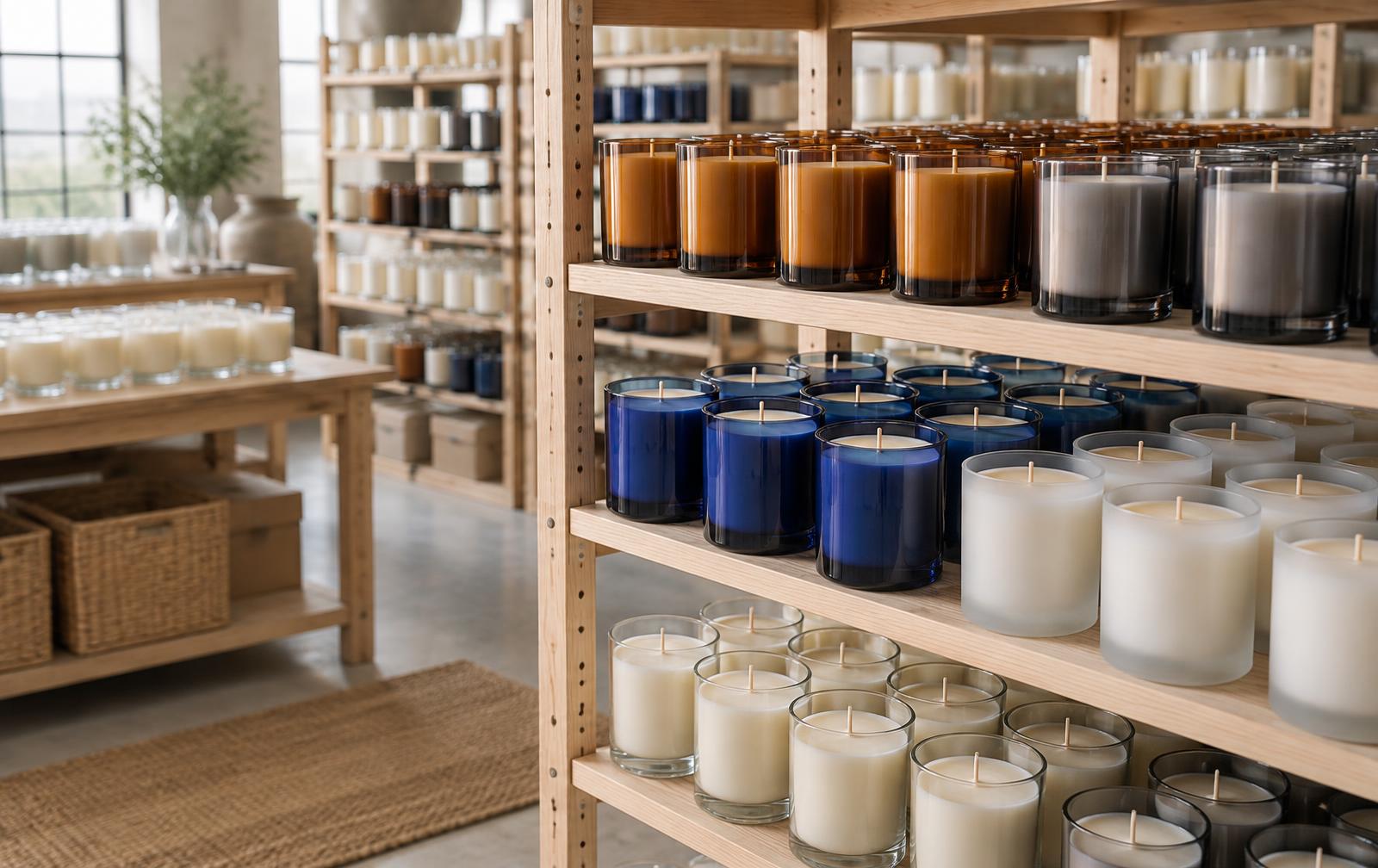
- A vessel from the manufacturer’s standard library. Stock vessels skip tooling costs and glassware minimums entirely. There’s more variety in a good library than most founders expect — colors, finishes, lids — so start there before requesting something custom.
- Labels before boxes. A beautiful label on a stock vessel launches cleanly at low minimums. Custom printed boxes and special finishes like foil or embossing typically carry higher minimums and plate fees — a great upgrade for run two, once the scent is proven.
- A reorder plan. Ask how fast a repeat run turns around before you launch. Selling out is only a win if you can restock while customers still remember you.
One more thing founders overlook: ask how the minimum is counted. Some manufacturers will let you spread it across product types — candles and room sprays sharing the same fragrance, for example. Not everyone offers that, but it’s worth asking before you settle on a partner.
When a Low Minimum Is a Red Flag
A genuinely low minimum is a manufacturing capability, not a marketing claim. If a company advertises runs of 20 or 25 candles at prices that seem too good, ask what’s actually happening:
- Is the candle hand-poured in small batches — slower turnaround, less consistency run to run?
- Are wicks burn-tested for your specific vessel and wax, or pulled from a generic spec sheet?
- Is the unit price honest, or quietly inflated to cover setup work — leaving you no room to wholesale later?
Fifty units is roughly the floor where a real production run still makes sense for both sides: professional vessels, tested wicks, consistent pours, printed labels. Below that, you’re usually buying a very expensive hobby kit.
Curious how minimums work behind the scenes — and why they exist at all? We broke that down separately in Candle Manufacturer MOQs: What to Expect.
Questions to Ask a Low-MOQ Manufacturer
Before you commit your launch budget, ask:
- Is the minimum per scent, per order, or per product type?
- What’s included at the minimum — wick testing, labels, lids?
- What does my unit price look like at 50 units, and at 250?
- How long does a reorder take once I sell out?
- Can I start with stock vessels and packaging, then upgrade on a later run?
A good low-MOQ partner will walk through all of these with you. Don’t expect instant pricing, though — a real quote depends on details: your fragrance, vessel size, and packaging elements. A manufacturer who quotes a firm unit price before knowing those is guessing, and you’ll pay for the guesswork later.
The Short Version
- A small first run buys proof, cash flow and freedom to adjust — the three things a new brand needs most
- Plan 50 units around one to three scents, a stock vessel, and labels before custom boxes
- Ask how the minimum is counted — some manufacturers let you spread it across product types
- Very small runs at very low prices usually mean hand-pouring, generic wicks or inflated unit costs
- The goal isn’t a big opening order — it’s a sell-out-and-reorder loop
Ready When You Are
At Unique Candles Midwest, 50 units is a real production run — wick testing, vessels, labels and packaging under one roof in the USA. Please note fragrance development isn't offered at the 50-unit level; at that quantity you'll choose from an existing fragrance library. Candles, room sprays, diffusers, wax melts and perfume are all produced in-house, so your line can grow one product at a time.
Want to see what your first run could look like? Explore your vessel, size, lid and label options in our Design Studio, or just tell us what you’re launching — we’ll help you shape a first run that fits your budget.