Search “private label candles” and you’ll find hundreds of manufacturers promising the same thing: your label, our candles. It sounds simple — and it is, once you understand what’s actually on the table, what it costs, and where the differences between manufacturers hide.
This guide walks through what private label really means, how it compares to going fully custom, what a small first run looks like, and the questions that separate a true production partner from a reseller with a spreadsheet.
What Private Label Actually Means
In a private label arrangement, the manufacturer makes the candle — the vessel, the wax blend, the fragrance, the wick, the burn testing — and you put your brand on it. The products are built from the manufacturer’s proven catalog: fragrance library, standard vessels, lids, labels and packaging they already produce every day.
What you’re buying isn’t just a candle. It’s everything behind it: wicks that have been tested for that exact vessel and wax, fragrances that throw properly, production equipment that pours 500 units as consistently as it pours 50. None of that is cheap or fast to build yourself.
The trade-off is real and worth naming: you don’t own the formula. A good private label partner offsets that with exclusivity options on scents or colorways, deep customization of the brand-facing elements — labels, printing, packaging — and the ability to move you toward fully custom products as you grow.
Private Label vs. Fully Custom
Fully custom means the fragrance blend, vessel and packaging are developed for you from scratch. It produces something truly unique — and it comes with development costs, custom tooling, sample rounds, and minimums that usually start in the thousands. For a first launch, that’s often money spent before you’ve proven anyone wants the product.
Private label inverts the order: prove the brand first, customize deeper later. A typical path looks like this:
- Run one: stock vessels, a curated fragrance selection from the manufacturer’s library, printed labels or a simple print on the vessel.
- Run two: upgrade packaging — a printed box, foil or embossed label details — once the scent is proven.
- Run three and beyond: custom fragrances, color-matched vessels, unique packaging as volume justifies it.
The brands that succeed with custom almost always started with private label. The reverse — going fully custom on day one — burns budget on uniqueness before a single customer has voted with their wallet.
Private label isn’t a lesser version of custom. It’s the on-ramp to it.
What a Small Private Label Run Looks Like
Minimums are the first question every founder asks, and they vary wildly — many manufacturers won’t talk below 250 or 500 units, and some start at 1,000. But a genuine low minimum exists, and at Unique Candles Midwest it’s 50 units.
At that size, a real production run looks like:
- One to three fragrances chosen from the manufacturer’s existing library — at 50 units you’re selecting proven scents, not developing new ones.
- Standard vessels from the manufacturer’s library — glass or ceramic, in the colors and finishes they already run. This skips tooling costs entirely.
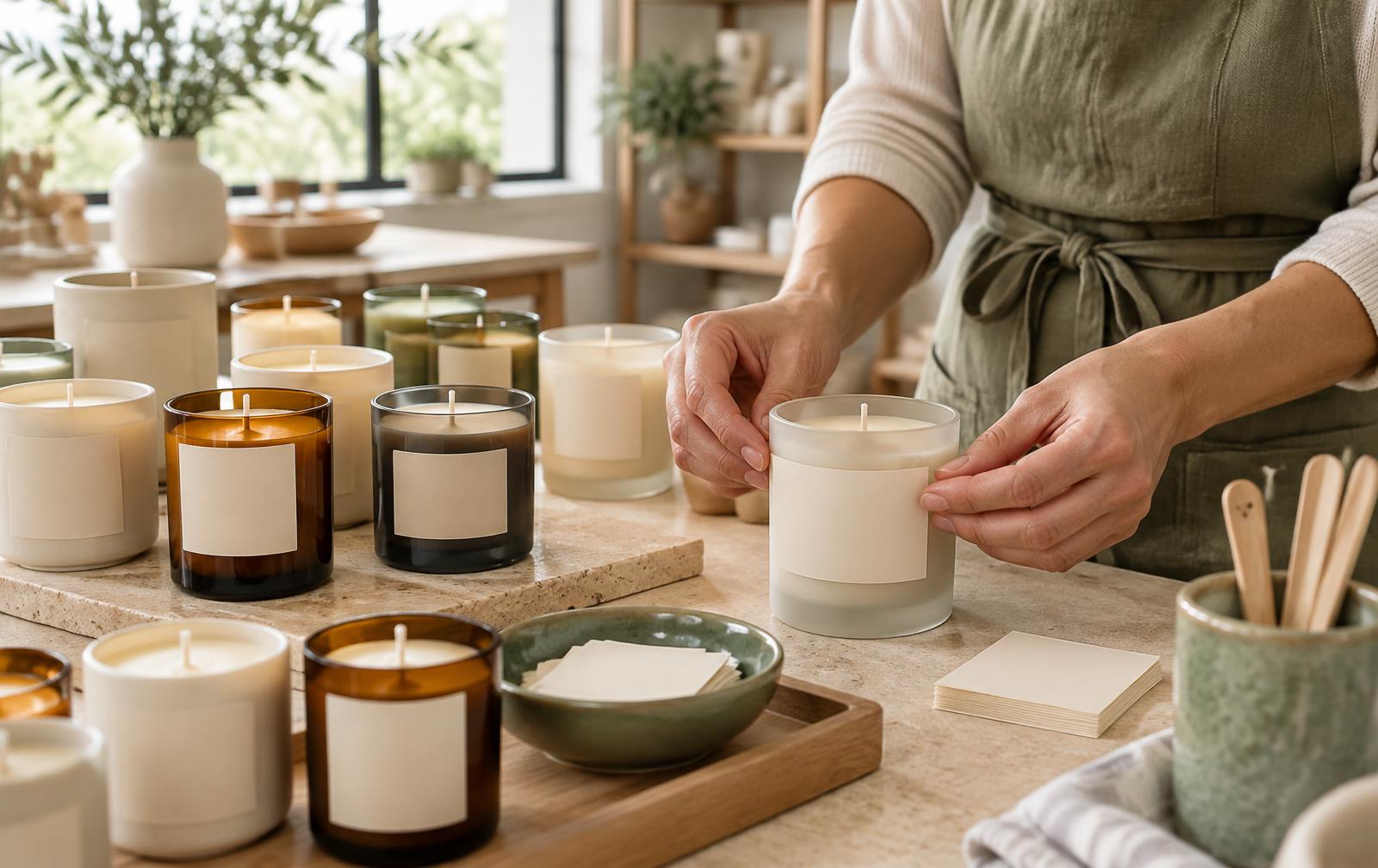
- Your brand on the product — full-color adhesive labels, or direct printing on the vessel at higher quantities.
- Packaging that matches your stage — labels first, custom printed boxes as an upgrade when volume supports it.
One thing worth knowing before you ask: a firm unit price only comes together once the fragrance, vessel size and packaging elements are settled. A manufacturer who quotes instantly without those details isn’t being efficient — they’re guessing, and you’ll pay for the guesswork later.
How to Choose a Private Label Partner
The label on the box tells you nothing about what’s inside it. These are the questions that reveal the difference:
- Where is the product actually made? Some “manufacturers” import finished candles and relabel them. That means long reorders, little flexibility and no one accountable when something’s wrong.
- Are wicks burn-tested for the specific vessel and wax? A safe, clean burn is engineering, not luck.
- What’s in the fragrance library, and can I get samples first? You should never commit to a scent you haven’t smelled.
- How is the minimum counted? Per scent? Per order? Some manufacturers let you spread it across product types — candles and room sprays sharing the same fragrance, for example. Not everyone offers that, but it’s worth asking.
- What can grow with me? Ask what upgrades are available on later runs — printed boxes, foil and embossing, custom fragrance development, color matching — so you know the ceiling isn’t right above your first order.
Red Flags to Walk Away From
- No samples, no exceptions. If you can’t smell the fragrance or hold the vessel before ordering, neither claim is trustworthy.
- Instant firm pricing. A real quote depends on fragrance, vessel size and packaging. A price given in sixty seconds is a placeholder that will change.
- Vague about production. “We handle everything” without being able to say where pouring, wicking and labeling happen usually means someone else’s factory is involved — and your timeline lives in their hands.
- Minimums too good to be true. Runs of 10 or 20 candles usually mean hand-pouring, generic wicks and unit prices inflated to cover setup — no room to wholesale later.
The Short Version
- Private label = the manufacturer’s proven products, your brand — the fastest route to a real line
- It’s the on-ramp to custom: stock vessels and library scents first, bespoke everything on later runs
- Ask where the candles are made, how wicks are tested, and whether the minimum counts per scent or per order
- No samples, instant quotes, or 10-unit minimums are signs to keep looking
- Start with the smallest run that’s still a real production run — then scale what sells
Ready When You Are
At Unique Candles Midwest, private label starts at 50 units — a real production run with tested wicks, professional vessels and your brand on every one, made in the USA. Candles, room sprays, diffusers, wax melts and perfume are all produced in-house, so your line can grow one product at a time. Please note fragrance development isn’t offered at the 50-unit level; at that quantity you’ll choose from our existing fragrance library.
Want to see your label on a real vessel? Explore sizes, vessel colors, lids, labels and packaging in our Design Studio — or tell us about your brand and we’ll help you shape a first run that fits.